Why frontier AI is becoming the fastest depreciating asset in enterprise technology
Somewhere in the past two years, the debate over artificial intelligence acquired a costume department.
Open models wear the white coat. They get the daylight, the globe, the cheerful crowd holding puzzle pieces. Closed models wear the black coat. They get the fortress wall, the padlocks, and a watchtower for good measure. It is a satisfying picture. It is also most of the reason nobody is getting anywhere.
Look at what the picture insists on. Two sides. One rope. A winner. Nearly every article, every conference panel, and every congressional hearing accepts that framing and then argues about which side to cheer for. The framing is the mistake.
Boards do not buy models. They allocate capital. Chief information officers do not buy intelligence. They allocate scarce resources against uncertain returns. Investors do not much care whether one lab’s model edges another’s on a benchmark. They care where margins migrate. Viewed through the lens that businesses actually use, the tug-of-war dissolves, and a different picture appears in its place.
Here is that picture in one sentence. Frontier intelligence is not an asset. It is a lease, and the lease runs about six months.
The gap between the best model money can rent and the best model anyone can download has collapsed to a matter of months. Measured three different ways by three institutions with three different methods, the answer keeps coming back the same: the open alternative arrives four to seven months behind the closed frontier, at a fraction of the price, and the interval has been stable for a year and a half. Whatever capability you are paying frontier prices for today will be available on your own hardware, inside your own walls, before your fiscal year closes.
That single number rewrites the strategic question. The question is not which model to use. The question is what, if anything, your business should ever pay frontier prices for. This article is an attempt to answer it.
Part I: The market is asking the wrong question
First, the argument everyone is having instead, because it deserves a fair reading before it is set aside.
Begin with the licenses, since the word at the center of the fight has quietly stopped meaning anything. Moonshot’s Kimi K3, the largest open release in history at 2.8 trillion parameters, is called an open model absolutely everywhere. Read the license and you find that a model-as-a-service business above twenty million dollars in revenue needs a separate commercial agreement with Moonshot. Meta’s Llama license caps you at seven hundred million monthly users and obliges you to advertise Meta’s brand on your own product. Neither is open source by any definition the Open Source Initiative would sign. The industry knows this, which is why the term of art migrated from open source to open weights somewhere around 2024. That migration was not a technical clarification. It was a legal one, performed by lawyers, and it worked beautifully. The unencumbered tier, the models released under Apache 2.0 with no strings at all, is smaller than the noise suggests: Thinking Machines’ Inkling, Alibaba’s Qwen, Google’s Gemma, IBM’s Granite, Mistral, and, in a plot twist nobody scripted, OpenAI’s own gpt-oss.
The political fight over these releases reached its peak this July, and what it revealed is worth pausing on. A letter titled Open Weights and American AI Leadership appeared, shepherded by Microsoft, hosted by Nvidia, and launched by Jensen Huang’s first ever post on X. A man waits sixty-two years to tweet, and this is what he picks. Well over a hundred companies signed, from Meta and Palantir to the Linux Foundation. The letter was widely reported as an attack on closed models. It is nothing of the sort. It concedes that open weights carry real and distinct risks, and its central claim is narrow: relying solely on closed models is not inherently safe either, since they can be breached, misused, or fail in ways outsiders cannot detect.
The supposed opposition is just as miscast. Anthropic, the only major lab that declined to sign, is routinely described as wanting open models banned. Its chief executive opened his response with the opposite: Anthropic has never advocated for a ban on open-weights models, and restricting American businesses from using them would protect incumbents from competition without addressing any real risk. His actual position is that all sufficiently capable models, open and closed alike, should face mandatory safety testing, because release mode is not the variable that matters. Capability is.
Read closely, the two camps have already converged. Both accept capability-gated evaluation with a floor below which nothing applies. Europe has even built it: the AI Act exempts open models from its documentation burden until they cross a defined compute threshold, at which point the obligations become identical regardless of how the weights are released. The one live disagreement is timing, whether regulators may act before harms are demonstrated, and one narrower fight over distillation, the industrial-scale copying of frontier models through their own APIs, which one side calls learning and the other calls theft. Those disputes are real. For the largest open releases, the case for testing before release is strong for a simple reason: a closed model that goes wrong can be withdrawn, while an open model that goes wrong is permanent. Encouragingly, the research suggests this is solvable at the source. Models trained with dangerous content filtered out of the training data have proven more than ten times harder to corrupt afterward than models patched with guardrails at the end.
All of it matters. None of it is the strategic story. Four days after the open-weights letter appeared, more than 1,300 employees of the same frontier labs, including senior scientists from every major one, signed a separate document asking governments to help slow automated AI development down. The companies signed one letter. Their scientists signed the other. When the people building the technology cannot agree on which axis matters, it is a reasonable guess that the axis being debated in public is not the important one.
The important one is economic, and it is measured in months.
Part II: The Six-Month Lease
Every previous era of enterprise technology ran on a comfortable assumption. Capability, once purchased, was yours. The software did not degrade because a competitor bought a newer version. The advantage eroded slowly, on a schedule measured in years, and procurement was built around that schedule.
Frontier intelligence broke the assumption, and the evidence is unusually clean. Epoch AI, which tracks model capability on a composite index, puts open models roughly four months behind the closed frontier. OpenRouter, which watches what millions of developers actually run, reports a stable gap of three to six months that has held for eighteen months, and notes that the frontier labs do not appear to be accelerating away. The United Kingdom’s AI Security Institute, measuring the capabilities that worry governments most, finds four to seven months, and narrowing. Three methods. Three institutions. One unit of measurement.
Now attach prices to that interval, because this is where the strategy writes itself. The same government institute published the cost of running identical tasks, solved with identical reliability, on frontier and open models. On the hardest class of task, the frontier model cost $12.50 per task and the open model cost twenty-eight cents.
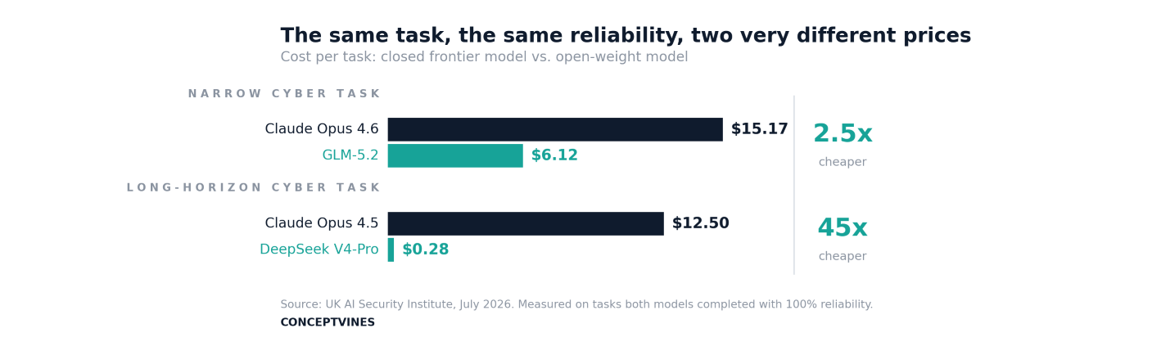
Two and a half times cheaper is a procurement conversation. Forty-five times cheaper is a different conversation entirely, the kind that ends with someone asking why we are still doing it the other way.
Put the two numbers together and the lease becomes visible. You can rent the very best reasoning on earth today, at a substantial premium. In roughly six months, capability indistinguishable from it will be running on infrastructure you own, at commodity prices, with no meter attached. Paying the premium is therefore a bet that six months of borrowed advantage is worth more than the fee. Sometimes it is. A drug discovered earlier, a market entered first, a contract won because your agent reasoned better than theirs. But that is what the payment is. Not a technology purchase. A time purchase.
Renting time can be brilliant strategy. Renting time without knowing that is what you are doing is how budgets disappear.
Part III: The depreciation curve nobody has booked
Enterprises are fluent in depreciation. Buildings write down over thirty years, network equipment over seven, servers over five, laptops over three. The schedule is boring, and its boringness is the point. It forces an honest conversation about what an asset is worth over time, before the money is spent.
Now place frontier intelligence on that curve. The premium you pay for exclusive access to the best model does not depreciate over thirty years, or five, or three. It halves in something like two quarters, because that is when equivalent capability arrives at open-weight prices. Nothing in the history of enterprise technology has depreciated this fast while being purchased this enthusiastically.
The subtlety worth a moment of any board’s time is what exactly is depreciating. The model itself works as well as it ever did. What evaporates is the scarcity. You did not pay frontier prices for the capability. You paid frontier prices for the exclusivity of the capability, and exclusivity is the component with the six-month half-life. The function endures. The premium does not.
The industry has seen fast depreciation before, and survived it, which makes the current blindness stranger. Moore’s law halved the value of computing hardware on a schedule too, but it did so predictably, over years, and an entire discipline of technology asset management grew up around the curve. Enterprises learned when to buy, when to lease, and when to wait. No equivalent discipline yet exists for intelligence. The curve is steeper, the spending is larger, and the finance function is mostly not in the room.
Accounting has not caught up with any of this. The same chief financial officer who would never approve a thirty-year bond to finance a laptop fleet will approve an unbounded API budget without once asking for the depreciation schedule of the advantage it buys. Token spending is treated as an operating expense, small enough per unit to escape scrutiny, which neatly hides the fact that the enterprise is renting, at premium rates, an asset whose premium is evaporating on a known clock.
And there is a second curve, running the opposite direction, that makes the first one strategic rather than merely annoying. While rented intelligence depreciates, owned context appreciates. Your data, your domain knowledge, the map of how your business actually works, the fine-tuned models that encode judgment your competitors do not have: every one of these compounds with use. Microsoft’s own chief executive said the quiet part in July: enterprises using proprietary models pay twice, once in subscription fees and once in the business knowledge embedded in every prompt and correction they send upstream. When the company that rents you the API says you are overpaying in knowledge, write it down.
Two curves, crossing. Everything an enterprise rents loses its premium in months. Everything it teaches, integrates, and owns gains value for years. The whole discipline of AI strategy reduces to keeping the right things on the right curve. Which raises the practical question: how do you tell them apart?
Part IV: The Depreciation Test
Here is a test any executive team can run on any AI workload, this quarter, with no consultants. Five questions. Easy to ask. Unpleasant to answer honestly.
The first is half-life. Will this workload still require frontier capability in six months, or are we renting something that is about to be free? Most enterprise work is not a frontier problem. It is a throughput problem wearing a frontier price tag.
The second is egress. Does the value of this task live in the prompt? If your proprietary knowledge rides along in the context window, you are paying a subscription for the privilege of tutoring someone else’s model.
The third is ceiling. Is factuality or novel reasoning the binding constraint, or is it volume on a well-specified task? Closed frontier models still hold a real edge where hallucination is expensive, and that edge is worth paying for. But if the task is volume, you have bought a Formula One car to deliver parcels.
The fourth is recall. If this model were withdrawn, deprecated, or geo-restricted tomorrow, what happens to the business? This is not hypothetical. An export control directive forced one frontier lab to broadly disable a flagship model this year, and open alternatives picked up enterprise customers within days on continuity alone. A capability someone else can switch off is not a foundation. It is a feed.
The fifth is compounding. Does each deployment lower the cost of the next one, or does the meter reset? An ontology you own compounds. An API call does not.
Score a portfolio honestly against those five questions and a pattern emerges almost immediately. A small number of workloads clear the bar for frontier pricing. They involve novel reasoning, high-consequence decisions, unforgiving factuality requirements, or a regulator who expects a named vendor standing behind the output. Everything else, which is to say most of the portfolio, fails at least one question, and usually three.

That pattern is not an argument against frontier models. It is an argument for precision about where they earn their premium. Which leads to the operating model.
Part V: Lease the frontier. Own the foundation.
The strategy that falls out of the Depreciation Test fits in six words. Lease the frontier. Own the foundation.
Lease the frontier means using the best closed models deliberately, for the narrow set of workloads where six months of borrowed advantage creates business value nothing else can: the genuinely novel problem, the long-horizon agentic work, the decision where a hallucination costs more than a year of API fees, the regulated domain where an accountable vendor is a procurement requirement rather than a preference. Pay the premium there gladly. That is what it is for.
Own the foundation means everything else runs on infrastructure you control. The ontology that maps your business. The data that trains your edge. The fine-tuned open models running inside your own perimeter, encoding judgment that never leaves the building. The learning loop, so that every correction your people make teaches your asset instead of your vendor’s.
The pattern is no longer theoretical. It is visible at every altitude of the market.
At the top, Bridgewater worked with Thinking Machines to fine-tune an open model on the firm’s own investment reasoning, and reported that it beat leading proprietary models on financial reasoning at roughly one fourteenth the running cost. Both parties self-reported, so discount accordingly, but notice what the cost number conceals. A fund building signals on a rented model is renting a signal its competitors can rent too, pushing material nonpublic information through someone else’s infrastructure, and explaining a black box to a regulator whose model risk rules were written for logistic regressions. Owned weights on owned hardware retire three problems at once, and only one of them is the bill.
In the middle, software firms have quietly concluded the same thing. Open coding models now perform within a few points of the frontier on the industry’s hardest benchmarks, at pennies per million tokens. An independent software vendor can run near-frontier coding capability inside its own network for the price of the GPUs, with no source code leaving the building and no per-seat license on a workforce whose shape is about to change anyway.
At the floor, the small models quietly got good, and the floor is where most of the world’s work actually happens. Models small enough for a phone now match what required a data center two years ago. The median model downloaded from the world’s largest model repository is under half a billion parameters and has barely moved in three years, because most work does not need a genius. It needs a competent, cheap, private specialist that answers in fifty milliseconds and never phones home.
For the executives responsible for all this, the operating model implies specific changes in behavior, and they are worth stating plainly.
For the CIO, it means the model portfolio becomes a portfolio in the financial sense, with a thin, expensive frontier tier justified workload by workload, and a thick, owned tier where the compounding happens. It also means building the internal capability the strategy assumes. Owning the foundation is not free. It requires engineers who can fine-tune and operate models, an evaluation practice that can tell when the open alternative has caught up, and the organizational discipline to move workloads down the curve on schedule rather than letting incumbency decide. The firms that treated cloud cost management as a discipline rather than an afterthought are the template. The same rigor, pointed at intelligence.
For procurement, it means AI contracts get treated like leases rather than licenses: shorter terms, exit rights, portability of prompts and fine-tuning data, and a hard look at any agreement whose economics assume the premium will hold. The single most valuable clause in any AI contract signed this year is the one that makes leaving cheap, because the entire strategic environment is designed to make leaving valuable.
For the board, it means one new question in every AI review, and it is the question this entire article exists to install: what is the depreciation schedule on this spend, and what are we building that appreciates against it? A board that asks only whether the company is using AI is auditing enthusiasm. A board that asks which side of the depreciation curve the money lands on is allocating capital.
None of this requires predicting which lab wins. That is the quiet luxury of the strategy. It works under every outcome, because it is built on the one variable that has proven stable while everything else churned: the interval.
Part VI: What happens next
The economics now in motion produce a market with a peculiar shape, and it is worth describing because most strategic plans still assume the old one.
At one end, frontier intelligence gets more expensive and more valuable, sold increasingly as outcomes rather than tokens. The frontier labs can see the depreciation curve too, and they are not going to sit on the wrong side of it. A closed lab is structurally punished for making its own tokens cheap, since every price cut accelerates the collapse of the premium it exists to charge. So the labs will move up the stack rather than down the price curve, into industry solutions, forward-deployed engineering, governance, and accountability. What they will sell by 2028 is not intelligence. Intelligence will be the cheapest line in the stack. They will sell certainty, vertically, with a name on the result.
At the other end, open and small models absorb the volume. By the middle of this year, open-weight models were already handling roughly a third of requests through major inference gateways, and the most-used models on the largest routing platforms were open ones. Volume is not revenue, and anyone declaring victory by counting requests is measuring the wrong thing. But anyone reassured because closed revenue is holding is making the same error backwards, and it is the more expensive version. Revenue lags the workloads.
The casualties gather in the middle. General-purpose, mid-tier, API-only models with no frontier capability and no cost advantage have nothing left to sell: too weak for the problems that justify a premium, too expensive for the problems that do not. Any business built on reselling commodity tokens at a markup is standing in that middle right now, and the rope is being pulled from both ends.
As for the two camps in the costume drama, they have already told you they agree, through actions rather than letters. Meta, which made open weights a matter of American industrial policy, shipped its newest flagship behind an API. Anthropic, cast all summer as the fortress, spent the summer publishing the training techniques that make open models safer to release. The hats were on the wrong heads all along, because the heads were never playing the game on the poster.
The asset nobody can download
Every transformative technology follows the same arc. Electricity was once so scarce that factories located themselves beside generating stations, and the men who controlled generation controlled industry. Then it became infrastructure, and the advantage moved to whoever used it best. Storage followed the arc. Networking followed it. Compute followed it, and within recent memory: companies once competed on the sophistication of their data centers, and now the cloud is a utility bill.
Intelligence is following the same arc, faster than any of its predecessors. The frontier will keep advancing, and the labs pushing it forward are doing some of the most consequential work of this century. But each advance now commoditizes on a six-month clock, which means raw intelligence is becoming infrastructure in real time, and infrastructure has never been where the durable advantage lives. The scarce asset is never the technology forever. The scarce asset is knowing when it stopped being scarce.
The companies that dominate the next decade will not be the ones that rented the smartest models. They will be the ones that understood exactly when intelligence stopped being scarce, paid frontier prices only for the six months that were worth it, and spent the savings building the one thing that appreciates while everything else in this industry depreciates: a foundation of data, judgment, and owned capability that no competitor can download.
The frontier is a lease. The foundation is the asset. Sign accordingly.